
Why was my move a blunder?
Your game review says "blunder" but not why. See the usual reasons a move is a blunder, and get your own move explained free from the game link.
Works with chess.com and Lichess, with a free account. We only read public games.
Your game review put a red mark on a move that looked fine to you. A blunder is a move that makes your position much worse than the best move would have. The review shows that it happened. This page covers the usual reasons why, and how to get your own move explained.
Paste the game link and Hint Chess goes through your mistakes one at a time. You try to find a better move, and then a coach explains what was wrong with yours in plain words. It works with chess.com and Lichess games. It's free, and it needs a free account.
The five usual reasons
1. It left something undefended
This is one of the most common blunders in club games. The piece you moved was guarding something: another piece, a pawn or a key square. When it left, that thing could be taken for free.
How to spot it: before you move a piece, ask what it is defending right now.
2. It walked into a tactic
Your move was safe by itself, but it put two of your pieces on the same line or within reach of the same knight. Your opponent then had a fork, a pin or a skewer. These are easy to miss because nothing is attacked on the move you play. The threat only appears one move later.
How to spot it: after choosing a move, look for your opponent's checks, captures and threats in the new position.
3. The trade didn't add up
You started a series of captures and came out behind. This often happens when you count the attackers but forget a defender that sits behind another piece, or when you give up a more valuable piece first.
How to spot it: count the whole exchange to the end, and count the values as well as the number of pieces.
4. It opened your king
A pawn move in front of your castled king, or a defender that moved away, gave your opponent an attack. These blunders can be hard to believe, because the punishment may be several moves away.
How to spot it: treat every pawn move near your king as permanent. Pawns can't go back.
5. It missed a better move
Sometimes your move wasn't bad in itself. The blunder was what you didn't play: your opponent had just made a mistake, and you had a winning capture or a mate. Reviews often mark this as a "miss".
How to spot it: when your opponent makes an unexpected move, check whether it was a mistake before you carry on with your own plan.
Why the engine's line doesn't always help
An engine-only review answers "why was this a blunder?" with a number and a line of moves. The line is correct, but you still have to work out the idea behind it. It also often shows the best defence, which is not the move you need to understand.
A useful answer names the reason in a sentence: "your knight was the only defender of the bishop". That is what Hint Chess gives you.
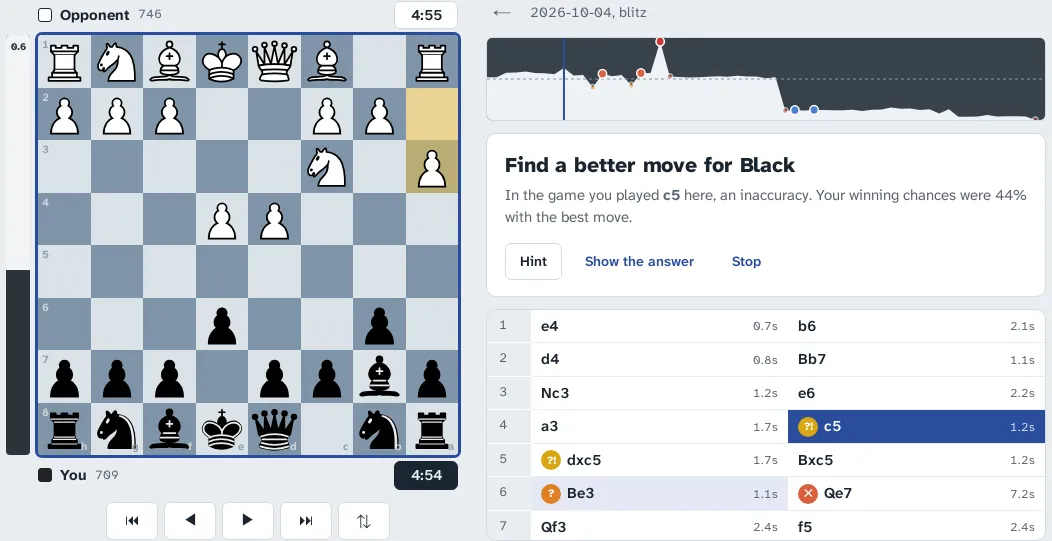
How Hint Chess explains your blunder
- Stockfish checks the game and marks each inaccuracy, mistake and blunder by how far your winning chances fell.
- You try again. The board goes back to the position before your move, and you look for something better. Hints are there if you want them.
- The coach explains in a few short steps: what your move allowed, how your opponent could punish it and why the better move works. Arrows show it on the board.
- The position comes back as a practice puzzle on a later day, so you can check the idea stuck.
Stockfish makes every verdict. The coach is a language model that only puts Stockfish's findings into words, and each lesson is checked against the engine's facts.
Find your most common blunder
One explained blunder is useful. A pattern is more useful. After a few reviewed games, Hint Chess sorts your mistakes by kind (hung pieces, missed tactics, lost material and so on) and shows which one costs you the most. Most players find that one or two kinds make up most of their losses.
Start with one game: paste its link in the box at the top. On any chess.com game you can also change chess.com to hintchess.com in the address bar.
More: free chess game review, game review with explanations, unlimited game review.
Questions
- What counts as a blunder?
- A move that makes your position much worse than the best move would have. Engines measure this as a drop in winning chances. A small drop is an inaccuracy, a bigger one is a mistake, and a very large one is a blunder.
- Why does the engine call my move a blunder when I won material?
- Usually because of what happens a few moves later. The piece you took was defended in a way that's easy to miss, the capture opened a line to your king, or it gave your opponent a strong reply. The explanation shows that reply on the board.
- Why is it a blunder if my opponent didn't punish it?
- A review judges the move, not the result. If your opponent missed the punishment, your move was still a blunder, and the review also marks their miss. A stronger opponent would have found it.
- The move looks fine to me. Is the engine wrong?
- Stockfish is rarely wrong about tactics. The usual cause is a reply you didn't consider. Try the position yourself, then read the explanation and play the line on the board.
- How do I stop blundering?
- Find out which kind of blunder you make most, and practise those positions. Before each move, check what your move leaves undefended and what your opponent's last move threatens.